
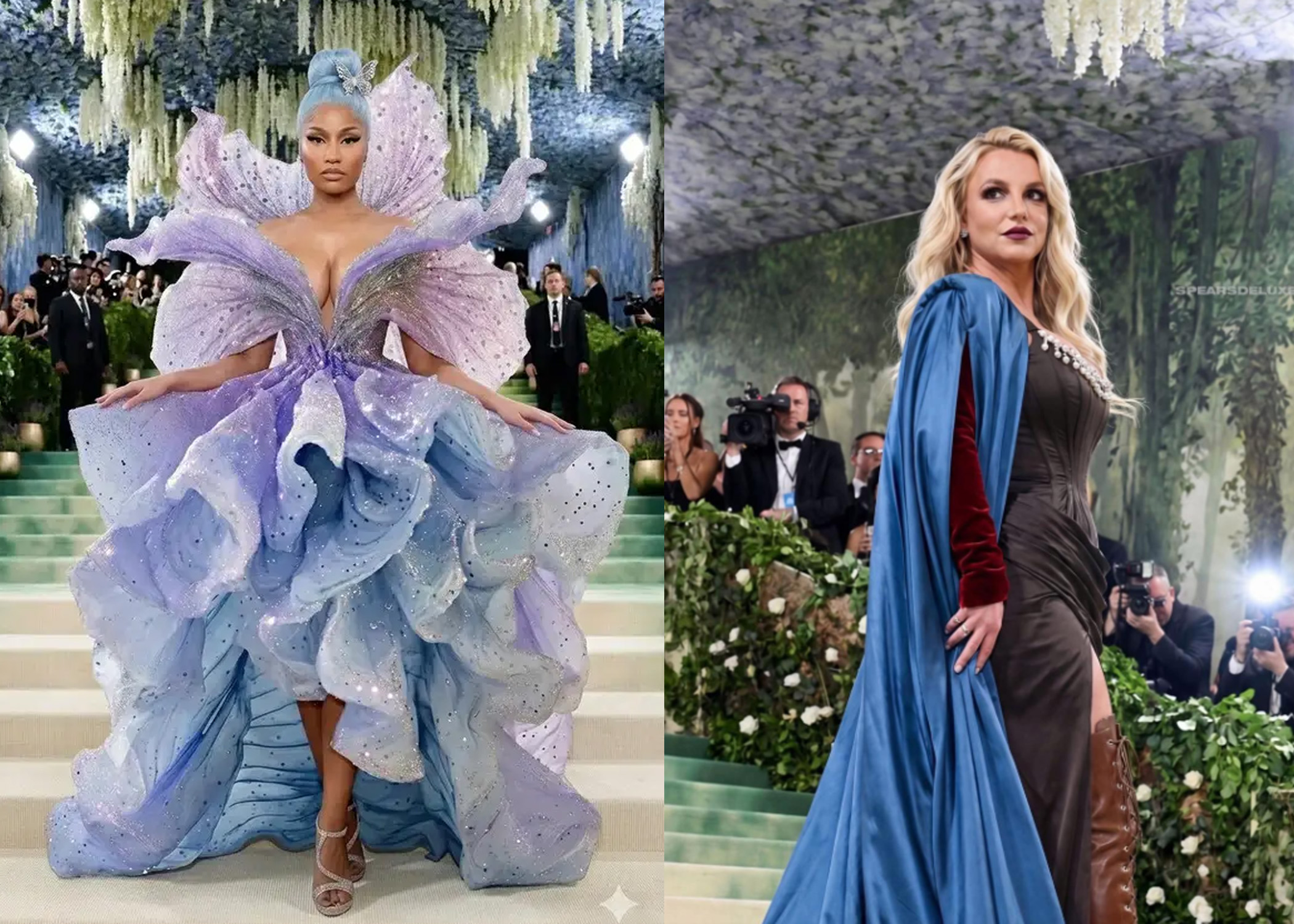
Millions of social media users were misled after AI-generated images of Britney Spears and Nicki Minaj at the 2026 Met Gala went viral, despite neither celebrity attending the event.
The fabricated images spread rapidly across platforms like Instagram and X, amassing more than three million combined views within hours. Their realism and alignment with the event’s “Fashion is Art” theme made them nearly indistinguishable from genuine red carpet coverage.
One widely shared image depicted Nicki Minaj in a sculptural lavender-to-blue gown that appeared perfectly tailored to the Met Gala’s aesthetic. The level of detail and thematic accuracy led many users to assume it was authentic.
Similarly, an image of Britney Spears showed her wearing a gown inspired by the Mona Lisa, reportedly conceptualized by illustrator Hayden Williams. The post, captioned as a real Met Gala appearance, drew enthusiastic reactions before users realized it was entirely AI-generated.
🚨 Nicki Minaj has arrived at the Met Gala #MetGala pic.twitter.com/TLY9ExAtTn
— poppy 🦋 (@notpopbase) May 4, 2026
The confusion was not limited to fan pages. A digital artist known as RickDick shared AI-created Met Gala looks featuring fictional models, some of which gained up to 900,000 likes. While positioned as artistic exploration, the lack of clear labeling allowed the images to circulate elsewhere as seemingly real.
The situation escalated when AI-generated content appeared to gain validation through search engines. Queries related to Met Gala attendees, including Anya Taylor-Joy, returned fabricated images presented as legitimate event photography, further blurring the line between fact and fiction.
The growing presence of AI-generated visuals has created a verification challenge for one of fashion’s most high-profile events.
Britney Spears STUNS at the #MetGala 2026! pic.twitter.com/XdU3KBhKFe
— SpearsDeluxe (@thespearsdeluxe) May 4, 2026
Experts warn that the event’s tradition of extravagant, avant-garde fashion makes it particularly vulnerable to AI manipulation. When audiences already expect surreal and artistic designs, distinguishing reality from fabrication becomes increasingly difficult.
The viral spread of AI-generated Met Gala images underscores a broader crisis in digital media, where realism no longer guarantees authenticity. As technology advances, platforms, creators, and audiences face growing pressure to verify what is real before it shapes public perception.